
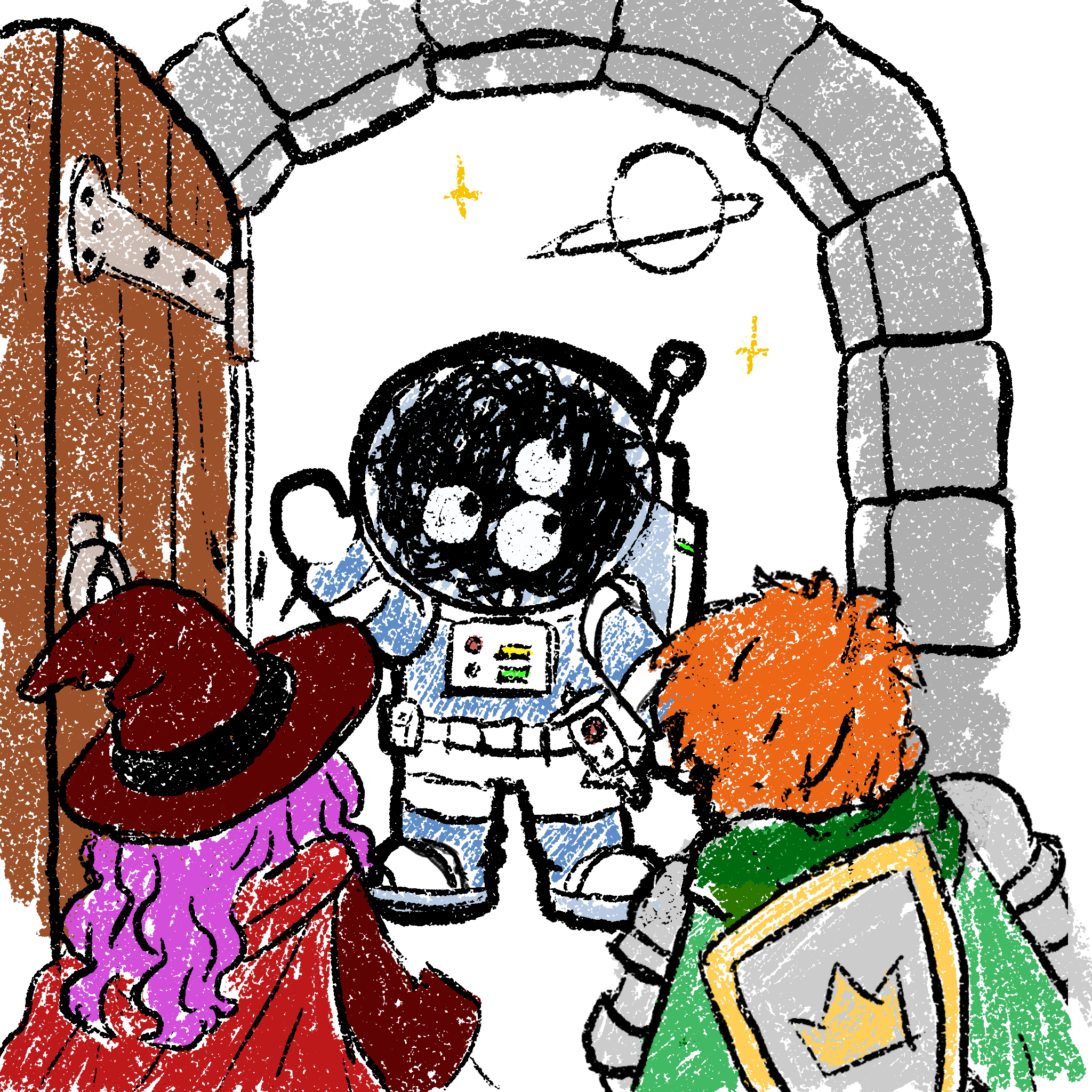
Games are interactive experiences. They only truly exist in the hands of their players, and the open nature of TTRPGs means that the same book can produce wildly different results.
That freedom is one of the medium’s greatest strengths. It also means that players can, and regularly do, play games wrong.
But what does that even mean?
Rules are boring
The urge to homebrew
Damian doesn’t like how Sneak Attack works in Dungeons & Dragons.
“Uhhh, it’s too OP!”
He is starting a new campaign, and he tells Sena, the player building a rogue, that he is going to homebrew a fantastic replacement for the key feature of their class.
“Trust me. It will make the experience better.”
But will it?
TTRPGs are flexible. Judgement calls can compensate for unstable systems, and experienced groups can reshape games around their needs. But has Damian taken the time to observe how his favourite game behaves without his changes? Does he understand what Sneak Attack contributes beyond its damage? More importantly, what about Sena?
Sena has played a rogue before. They understand how the class works, and they chose it based on the rules in the book. Damian may have created the greatest Sneak Attack rules ever written, but he has still changed the agreement under which Sena made that choice.
Game rules are not merely systems. They are a social contract: a shared reference that every player can use to understand what they have agreed to play together.
I love that TTRPGs are so hackable. I don’t love when someone feels entitled to rewrite the contract on everyone else’s behalf. It breaks trust, and the game can lose its most important quality: connecting people.
It also raises an uncomfortable question. When does a game stop being itself? At what point should a homebrew system be called a different game? Can I really claim to be playing a game after removing the core components that create its experience?
Games are alive
Players breaking your rules should not be treated as an act of defiance. As designers, we need to observe how our games behave once they leave our hands. Your ruleset is not the game. What happens at the table is.
When players hack your systems, ask why they felt the need to do it. Maybe a rule creates more friction than fun. Maybe the intended experience is not coming through. Maybe your audience wants something slightly different.
People breaking your rules is a learning opportunity.
Observing that divergence does not mean endorsing it. I don’t buy into the common disclaimer that rules can simply be ignored whenever players feel like it. It feels self-defeating. I designed these rules because I believe they produce the best version of this particular experience.
Players should also understand that changing a system can have long, invisible ramifications. A seemingly harmless adjustment can undermine a game dynamic altogether, believe me from experience.
So you can encourage your player hack games, test strange ideas and discover what they can become. But it should at least be explicit that such change is not trivial.
More importantly, players should be able to decide together what “wrong” means in term of rules. And yes, it includes fudging dice rolls.
Railroads are boring
Bringing a loaf of bread to a gunfight
Trinity likes to explore. She has her own idea of what the game’s fantasy should look like. She doesn’t care much about criminal ambition, turf wars, or becoming the most feared crew in Doskvol. She just wants to have fun.
The group is playing Blades in the Dark, but what Trinity really wants is to become a baker.
Yes, a baker.
She doesn’t break any mechanical rules. She creates a character by the book, rolls the right dice, and accepts the consequences of her actions. She simply uses every opportunity the game gives her to search for ingredients, perfect recipes, and build the bakery of her dreams.
The problem is that Blades in the Dark does not really care about bakeries. Its systems care about scores, crews, stress, heat, territory, and the consequences of pursuing a criminal life. Trinity can describe herself as a baker, but the game will keep pulling her toward the fantasy it was designed to produce.
By all mechanical accounts, she is playing correctly. So how can she be playing the game wrong?
When you open a TTRPG rulebook, its first pages usually explain who the players will become, what they will do, and what kind of experience the game was built to deliver. This is often phrased as an invitation rather than a rule.
But it is still a rule, just not a mechanical one. Players need to respect the intended fantasy of the game.
Trinity’s desire to run a bakery is perfectly legitimate. It simply requires an experience that this game was not designed to provide. There are thousands of TTRPGs out there. Somewhere among them, there is probably a game that wants her to bake that bread.
Carrots, sticks and cages
How can a designer protect their experience from an army of Trinities, ready to turn an apocalyptic wasteland into a cosy gardening game?
The obvious answer is communication. Take the time to clearly articulate your game’s intended experience. Tell players who they are, what they will do, and why doing it should be exciting. Don’t be afraid to explain how they are expected to behave.
But an introductory paragraph is not enough. Your mechanics should reward players for engaging meaningfully with the fantasy.
Identify the game’s core verbs. Make those actions interesting, consistent, and rewarding. Build an incentive loop that repeatedly draws players toward the experience you promised them. If the experience calls for it, you can even punish players for rejecting that fantasy.
OSR games are often good at this. A careless adventurer who charges into danger with big boots and a loud voice may quickly end up in the graveyard. The consequences reinforce the fantasy.
There is also virtue in thinking your core loop as a close environment. It is often a concept that is frowned upon in our circle, yet I don’t think RPG experiences should be fully open.
Strict objectives, requirements, timers, and consequences can make a world feel alive while gently caging players inside the intended experience. Don’t leave inexperienced GMs alone to preserve the shape of your game while players pull it in every possible direction.
Give them the tools to box the fantasy in. Then make the box so compelling that players want to stay inside it.
Conventions are boring
It’s just a joke bro…
Alex is joining a new group. Their friends are deeply invested in fantasy and immersion, but Alex likes to be a little chaotic. They crack jokes, reference memes, and refuse to take the fictional world too seriously.
Chances are that playing together will be complicated.
Alex follows every rule in the book. They engage with the central fantasy, pursue the adventure, and make decisions that move the game forward. So how can they possibly be playing it wrong?
Because the rules and fantasy are only parts of the experience.
At another table, Alex might be the perfect player. Their jokes could release tension, energise the group, and become the most memorable part of the campaign. Neither style is inherently correct.
In TTRPGs, perhaps more than in any other medium, the culture of play is central to the experience. Most of the game happens through social interaction. Tone, trust, authority, humour, attention, and respect all shape what the written rules become at the table.
This is where “playing the game wrong” becomes deeply subjective. Alex is not in conflict with the mechanics or the intended fantasy. They are in conflict with this group’s understanding of how that fantasy should be experienced.
However, this last point might be the most important for our topic. And paradoxically it is the one that I think designers struggle the most to reach for.
Tell me how you play, I’ll tell you who you are
When I designed Pocket Party, I discovered an article by Ben Robbins, the brilliant designer of Microscope. It made me realise that I had been thinking about what players would do in my game, but not enough about how I wanted them to treat one another while doing it.
Those values are not separate from the design. If, for example, the mechanics reward individual success at the expense of everyone else, asking players to cooperate politely will only go so far.
Safety tools and inclusive guidelines are important examples of designers intentionally shaping that culture. They tell players that comfort, boundaries, and communication are part of the game, not administrative concerns that sit outside the game.
But we can go further.
Games have introduced me to most of my friends. They continue to connect me with people through our online creator community. I cannot treat them as mere entertainment when they have had such a meaningful effect on how I relate to others.
Communicating your vision for the group’s social dynamics should be part of the game. Designers should not shy away from saying. Our games are a reflection of our values, and this value manifest in the relationships we create.
We design a social experience
Games exist at the table. They are a complex combination of the three elements mentioned above.
As designers, we need to consider all three layers and all the ways they can fall out of alignment. So in honour of Jesse Schell and his theory of lenses, I leave you with my first-ever lens.
LENS OF SOCIAL CONTRACT
In TTRPGs, more than in any other kind of game, the experience is a social contract. It defines the right way to play. Not as a universal truth imposed by the designer, but as an agreement that everyone at the table needs to understand and accept.
That contract has three connected layers:
- Mechanics: a game is a set of processes that players interact with
- Fantasy: a game delivers on an immersive fantasy
- Social dynamics: a game is played through social interaction between players
Next time you are designing a game, think about a few key questions:
- What kind of social dynamic does this mechanic create?
- How do I want people to feel toward one another when playing my game?
- How are the different social roles around the table shaping the fantasy?
- How do I guide players to translate mechanics into fiction?
- How does the group agree to change any of the 3 layers?
- Could a table of strangers understand this agreement from the book alone?
When your game reaches the table, nobody will care whether its designer thinks they are playing it “wrong.”
But you can give them the tools to agree on how to play it right.
This post was born out of a community conversation in our amazing discord creator community! I want to thank every member for their contribution. In a way they co-authored this article!
If you wanna join us and chat game design, follow the link -> https://discord.gg/Pyswmer6qm
Leave a Reply